
Taylor Shellfish: Blue Farming on Samish Bay
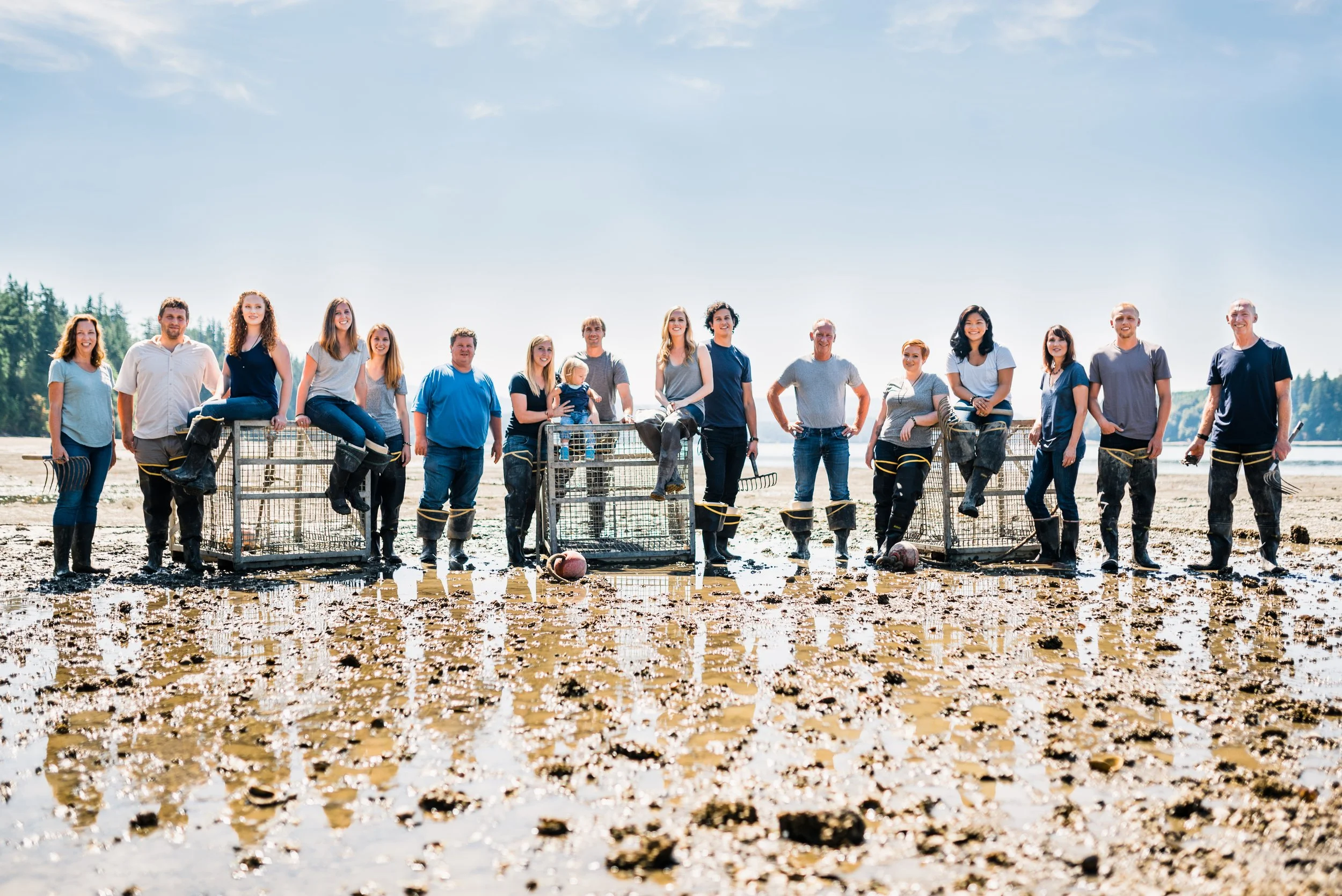
The Taylor Shellfish family. Photo: Taylor Shellfish.
Growing up, the Taylor family of Olympia spent time on boats and scows, says Bill Taylor, president of Taylor Shellfish Company. “Instead of riding around in a tractor we rode around in a boat.”
Water, not land, is where the Taylors grow their shellfish. They are farmers—let’s call them blue farmers—with a strong connection to the sea.
Blue farming, in Skagit County, has deep roots. “Skagit on the Half-Shell: History of the Shellfish Industry”, on display at the Skagit County Historical Museum through May 17, 2026, shows how the indigenous people of the Puget Sound have been tending to—and dining on—shellfish for generations. Today the Swinomish Tribal Community cultivates a traditional clam garden for tribal use and farms shellfish in Similk Bay.
Settlers began harvesting shellfish in Washington State as early as the 1860s, turning to shellfish farming as wild stocks diminished around the turn of the twentieth century.
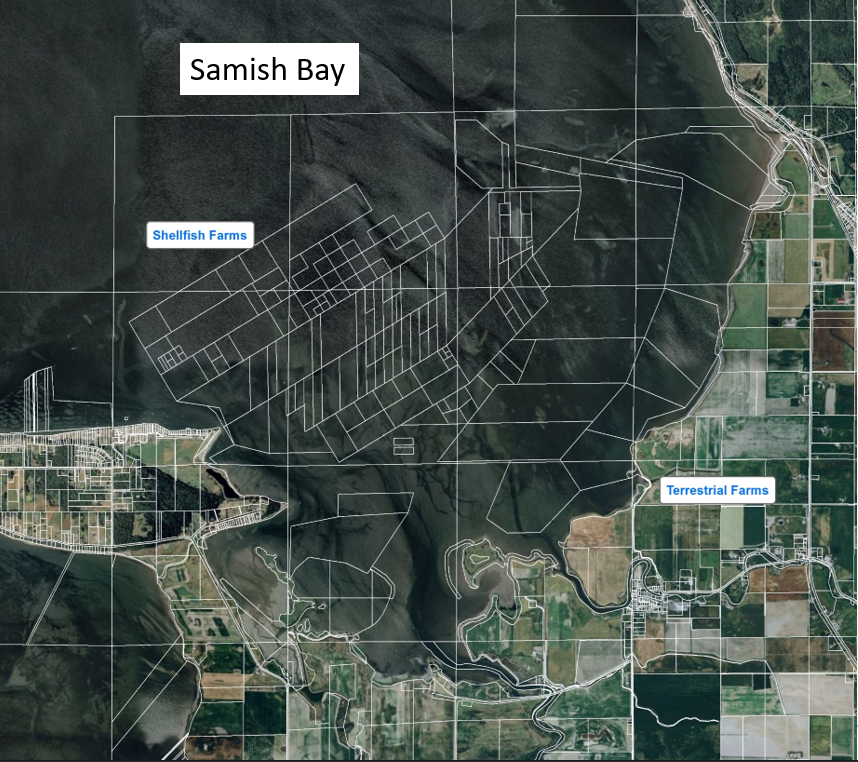
Overview of the shellfish farms in Samish Bay. Photo: Taylor Shellfish.
The Taylor family started farming shellfish in 1890 in southern Puget Sound and today Taylor Shellfish Farms owns and leases about 14,000 acres of tidelands in the state. Their 2,000-acre Skagit County farm in Samish Bay is one of their largest. Other farms are scattered around the inlets of Southern Puget Sound near their Shelton headquarters, the Hood Canal and on the coast in Willapa Bay.
Taylor’s Samish Bay farm produces approximately 5 million individual oysters, 1 million pounds of Manila clams and 30,000 pounds of geoduck clams annually. Nearby Chuckanut Shellfish produces approximately 100,000 pounds of Manila clams and 30,000 pounds of geoduck annually. Penn Cove Shellfish has a large clam and oyster farm in Samish and there are another five smaller operators as well.
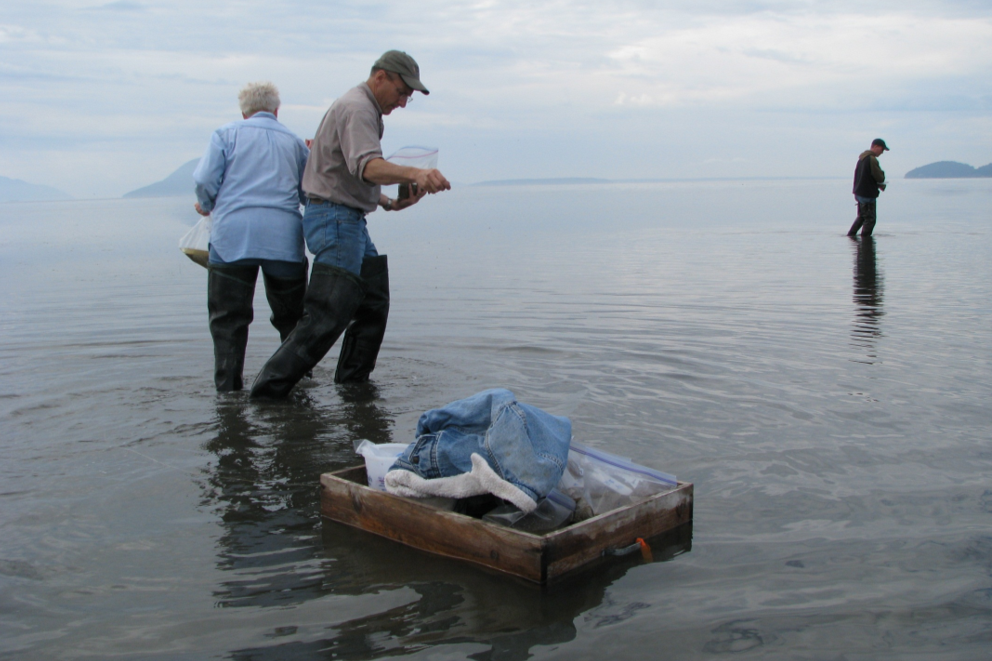
Planting clam seed, Samish Bay. Photo: Taylor Shellfish.
Just like terrestrial farmers, shellfish farmers “are planting seed, hoping it grows, and harvesting it,” says Taylor. But the challenges and opportunities differ.
Instead of weeds, shellfish farmers battle barnacles and predators. Water quality, not quantity, is a perennial challenge.
Rather than plant in spring and harvest in fall, the crops blue farmers grow can take 1-7 years to reach market size. They plant new shellfish “seed” in spring and summer and harvesting occurs year-round.
When terrestrial farmers sleep, blue farmers get to work. Shellfish live in the intertidal zone, covered by water at high tide. “From September to March, our beds are only accessible by night, when tides are low,” says Bill Dewey, Director of Public Affairs for Taylor Shellfish and founder-owner of Chuckanut Shellfish.
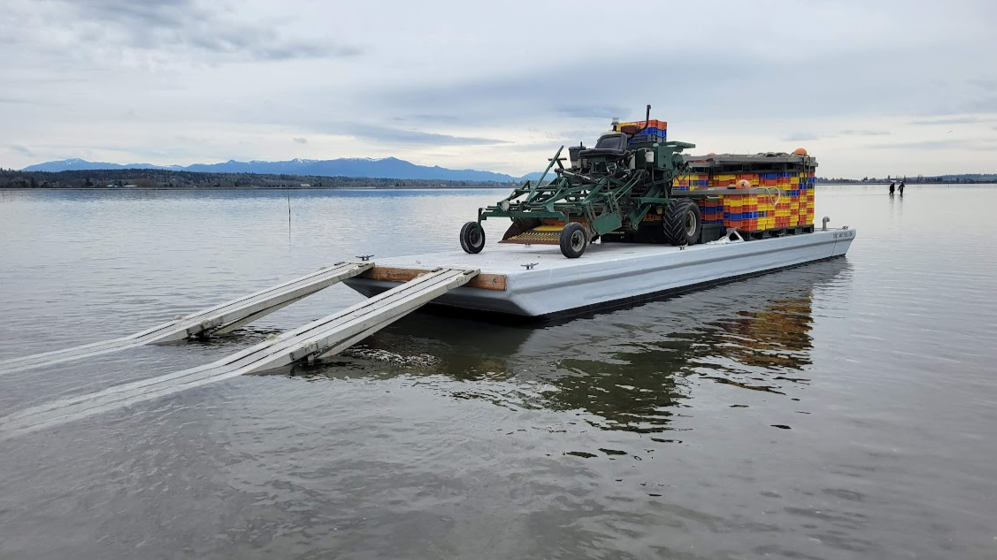
A harvester and gear on a scow. Photo: Taylor Shellfish.
Dozens of people work those winter overnight shifts in Samish Bay and hundreds across Taylor’s other farms. Tractors—the same models used for potato and bulb farming, adapted for shellfish—go out on barges and are driven on dry tidelands. Rigid plastic predator nets that protect manila clams from being eaten by Dungeness crab and Scoter ducks are checked and swept clean of sand and suffocating algae. “If a winter storm dislodges a net,” says Dewey, “within 24 hours 100% of the crop can be lost to hungry predators.”
It’s cold, wet work done in hip boots or chest waders. A lot of time is spent in boats, waiting for the tide to rise or fall. But being out in the night tides is part of the allure, says Dewey. “There’s just so much going on out there. In the winter you hear brant and ducks, and in the spring seal pups calling for their mothers who are fishing.”
Hundreds of beds in Samish Bay contain shellfish at different stages of maturity. Manila clams take about three years and geoduck clams need five or six to reach market size. Oysters are ready in just a year or two.
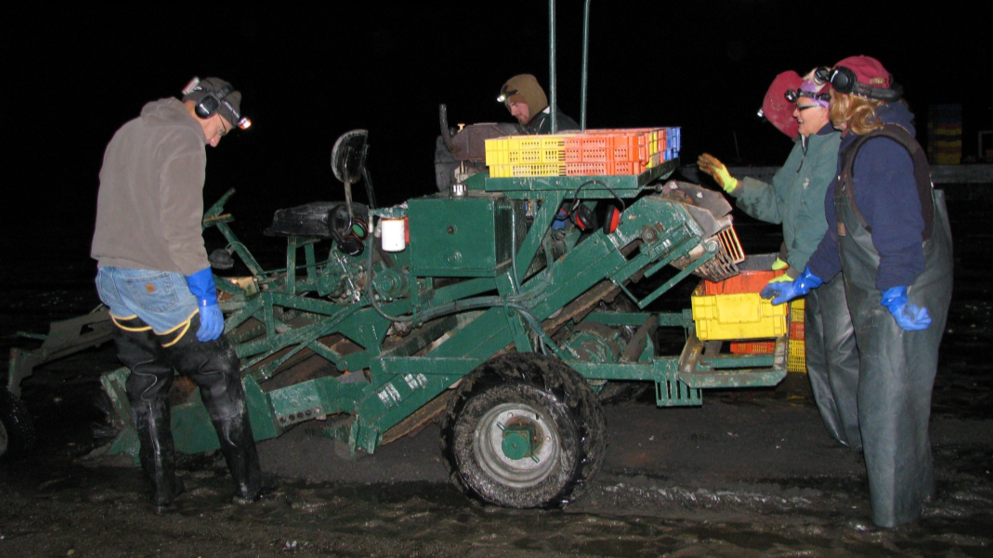
Night tide clam harvesting. Photo: Taylor Shellfish.
Harvest crews work when the tide is low, starting 45 minutes later each day (or night, in the winter) as the tide shifts. Shellfish are harvested into various containers at low tide that are retrieved at high tide by a workboat with a crane. They are offloaded on shore at Taylor’s Chuckanut Drive location and loaded onto semi-trucks destined for their processing facilities in Shelton, Washington. Once there, clams and oysters go into massive temperature-controlled seawater holding systems.
The oysters and clams are filter feeders. Oysters pump up to 55 gallons of water a day across their gills. As water passes through them, oysters extract oxygen and microscopic algae, cleaning seawater in the process.
Shellfish farming requires water that meets strict quality standards. Not all shellfish is cooked. Federal regulations are designed to ensure that oysters are safe to consume when raw. When water quality falls below these strict standards, shellfish cannot be harvested.
For decades Samish Bay waters were clean and shellfish farms harvested without restrictions. In the mid-1990s, harvest restrictions were placed on a large portion of the bay due to failing septic systems in Blanchard and Edison. As Dewey tells it, the Edison Sewerage Committee and Blanchard Poop Group were formed in response and “worked diligently to identify failing septic systems and figure out solutions.” Dewey worked with a group of volunteers developing a grant proposal that secured $500,000 to help replace failing septic systems and convert homes to low-flow fixtures. It helped pay for 27 of the new systems that went into Blanchard and contributed to components of a new sewer system in Edison. When those projects were completed the harvest restrictions were lifted by the Washington Department of Health (DOH). When they secured the grant, “Blanchard celebrated with a Poop Parade and Party,” remembers Dewey. “The Poop Princess rode on a toilet on the back of a 1940s flatbed truck decorated with toilet paper streamers, while everybody else decorated their bikes and riding mowers to ride along.” Taylor Shellfish provided lunch, of course. The parade and parties continued for another half dozen years, celebrating significant improvements in water quality on land and sea.
In 2011, degraded water quality from non-point pollution resulted in harvest restrictions on 4,000 acres in Samish Bay, when rain events flushed pollution from the watershed. In response, the Clean Samish Initiative was launched. It is a collective of more than 20 governmental, business and non-profit organizations actively interested in improving water quality in the Samish River and in Samish Bay. In 2025, thanks to the work of the Clean Samish Initiative and home and landowners addressing pollution sources, instead of closures around 65 days a year, harvest closures happen around 12-15 days per year.
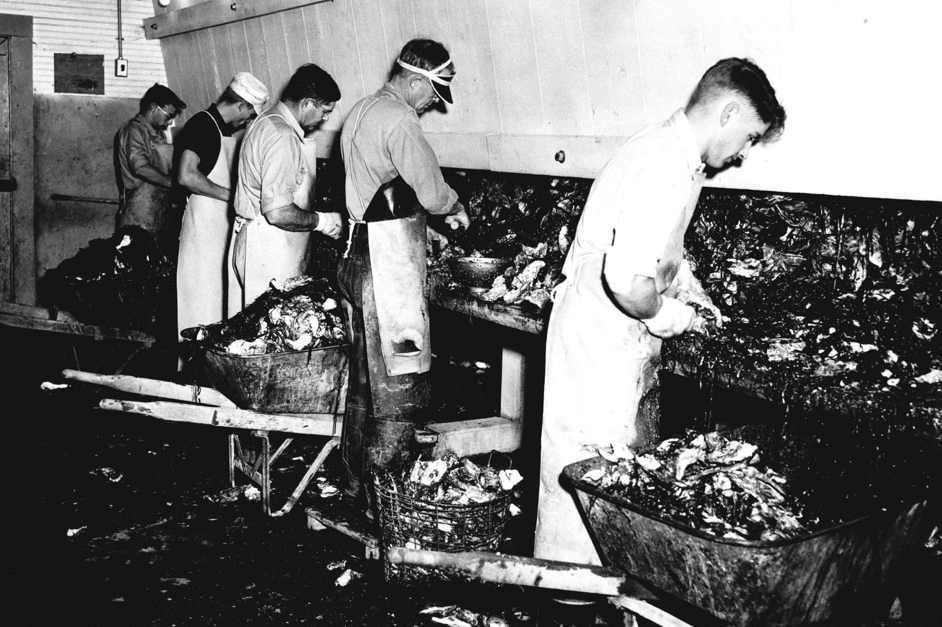
Image from Taylor’s archive of an oyster shucking room. Photo: Taylor Shellfish.
In addition to water quality changes, consumption trends have changed, too. At one time, about 90 percent of Taylor Shellfish oysters were shucked and packed into containers for sale to restaurants and grocery stores. Today 95 percent are sold live in the shell, destined for serving raw on the half shell or grilling on people’s barbeques. “When you grow an oyster and sell it on the half shell you can sell the story, the experience, and you can make a profit,” says Dewey.
At Taylor’s year-round Samish Oyster Bar and Shellfish Market, “on a sunny summer Saturday, the line is out to the railroad tracks,” says Dewey. “We have information kiosks and a demonstration plot that helps people understand that yes, we are part of the farming community, and shellfish are another food produced in Skagit County and they need clean water.”
Visit Taylor Shellfish during the Skagit Festival of Family Farms, and you’ll get a closer look at blue farming: how Taylor’s hatcheries and nurseries help produce the larvae needed to seed and reseed beds over and over again, and how the Shelton processing facility cleans shellfish to ensure consumer safety.
Washington State leads the country in farmed shellfish production. Company-wide, Taylor Shellfish employs over 600 people (40 in Skagit County) and produces 40 million oysters, 5 million pounds of Manila clams, 1.5 million pounds of mussels and 1 million pounds of geoduck clams annually.
After nearly 135 years in business, the whole Taylor family has strong ties to aquaculture. Bill Taylor thinks his predecessors would be happy with the fourth and fifth generations involved in the business. “I know my dad and uncle would be very pleased to see us continuing innovation, seeking more efficiency, better processes, and new markets.
“I’m constantly eating oysters when I’m out on the farms, and with four restaurants in the U.S. and one in Vancouver, British Columbia, we obviously enjoy feeding them to other people, too.”
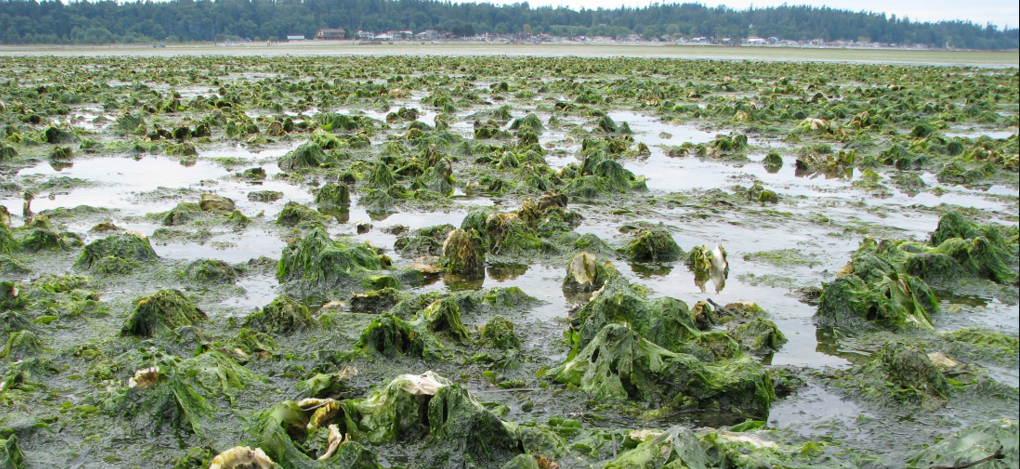
Oyster beds at low tide, Samish Bay. Photo: Taylor Shellfish.
Story by Anne Basye: info@skagitonians.org