
The Relicensing of the Skagit River Dams: Farmland at Risk
Did you know Seattle City Light is nearing a major decision about the future of the Skagit River — one that will shape our valley for the next 50 years — without a process that is open and transparent to Skagit citizens?
Negotiations about the relicensing of Seattle City Light’s three dams on the Skagit River have been conducted for years, often behind closed doors and with parties bound by confidentiality agreements. These conditions have generated local suspicions and frustrations. Reports that the relicensing will result in $150 million dedicated to salmon habitat restoration have raised concerns that Seattle City Light may use the power of eminent domain to condemn Skagit farmland and return it to estuary for salmon habitat (FOX 13 Seattle https://www.fox13seattle.com/news/seattle-city-light-land-grab). Recent updates from Seattle City Light that neglect to even mention agriculture reinforce a feeling that the utility is not listening to local concerns.
How We Got Here

Seattle City Light Diablo Dam, Skagit River. Photo: Canva
Ever since the first Skagit farmers sent their oats south to Seattle to feed horses in the 19th century, this agricultural valley and the growing city to the south have been connected. Those ties, while always close and important, have not always been easy. More than a century ago, Seattle turned its eyes north seeking a new source to power industrial and urban growth. The city found it on the Skagit River.
Beginning in the 1920s, Seattle City Light built three dams on the river: Gorge, Diablo, and Ross. Today, those dams supply Seattle with 20 percent of its electricity. After five years of negotiations, both in and out of public view, the Seattle City Light license to operate those dams for 50 more years is nearing a settlement. The licenses, granted by the Federal Energy Regulatory Commission, do not renew often; the last time was in 1995. Because these licenses remain in effect for decades, the renegotiation and renewal process is a rare opportunity for stakeholders to address critical issues.
The stakes are high for everyone who lives and works in the Skagit Valley. Among the most important and contentious issues is salmon restoration, especially given that Puget Sound Chinook have been listed as threatened under the Endangered Species Act since the previous relicensing.
Skagitonians to Preserve Farmland (SPF) believes this relicensing process provides an opportunity to strengthen protection of both fish and farmland. “We have long participated in and supported difficult but necessary conversations aimed at finding common ground between farmland preservation and salmon recovery,” SPF’s Executive Director Lora Claus wrote recently to the Seattle mayor and City Council. To find that common ground, however, requires more assurances from Seattle City Light that Skagit farmland will be protected and that Skagit voices will be influential in the decision-making process.
Why the Threat of Farmland Conversion Matters
Fox 13 Seattle reported in July that $150 million in habitat funding for salmon restoration is in the dam relicensing agreement. A massive influx of new habitat funding, without an explicit exclusion of eminent domain and without a clear and open process to engage local and tribal governments, is untenable. “If Seattle City Light does not intend to exercise eminent domain to take farmland for habitat, why won’t they exclude it as a possibility in the dam relicensing language?” said Claus, of SPF.
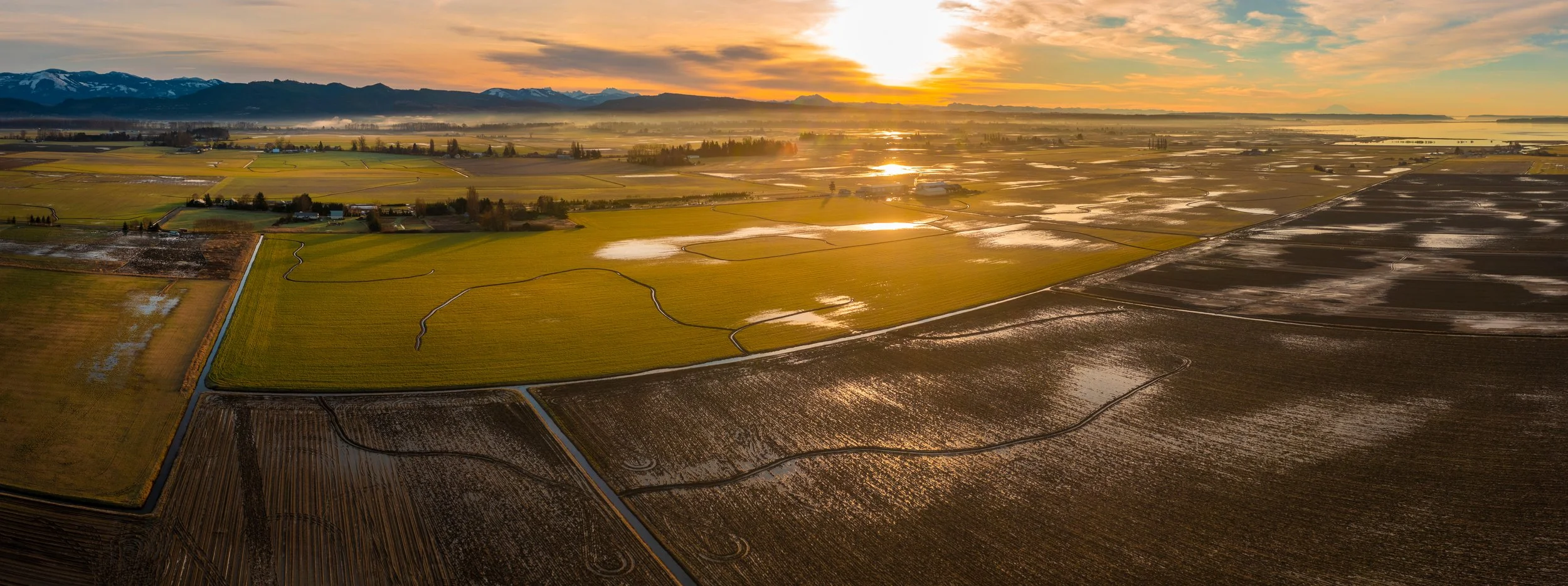
Arial shot of Skagit farmland. Photo: Stock
Establishing priorities for salmon recovery ought to be directed by locals who understand the system. Jenna Friebel, Executive Director of the Skagit Drainage and Irrigation Districts Consortium, has explained the complexity of Skagit’s agricultural infrastructure:
“The critical diking and drainage systems managed by Consortium member districts work as a single integrated system. Poorly selected or poorly designed restoration projects can have impacts far beyond the project footprint, jeopardizing thousands of acres of globally significant farmland that depend on this infrastructure to be productive.”

Fir Island. Photo: Gary Brown
The diking and drainage system protects not only 60,000 acres of prime farmland, but also the town of La Conner, State Route 20, and critical utilities.
The Call for Transparency and Local Leadership
In late July, the Skagit County Board of Commissioners announced it could not support the proposed dam relicensing agreement without “a clear, unequivocal and binding statement that the City of Seattle” will not condemn farmland for habitat restoration. Seattle City Light has repeatedly said it does not intend to condemn farmland but has not confirmed that this possibility has been excluded from the settlement language. With negotiations happening behind closed doors, the community remains in the dark.
Over this same period, the Skagit County Commissioners and Upper Skagit Indian Tribe have called for changes to the Skagit Watershed Council. The Council establishes priorities for funding habitat restoration projects. Under the state’s Salmon Recovery Act, that leadership is intended to come from local people who best understand the land and the systems that support it. A representative from Seattle City Light sits on the board, as well as having a position on the citizens’ committee tasked with prioritizing restoration projects; Skagit County and the Skagit Drainage and Irrigation Districts Consortium do not have similar representation.
“If habitat projects are conducted at random, without involving local and tribal governments, we could end up flooding valuable farmland and impacting critical infrastructure without making any progress towards bringing back endangered salmon. That’s the worst of both worlds,” said Claus, of SPF.
County Commissioners have called for Seattle City Light to give up its position on the Watershed Council to allow representation that centers Skagit tribes and local governments in selecting, planning, executing, and managing major restoration projects involving farmland and critical infrastructure.

Salmon moving through the Baker Dam Fish Passage, Baker River. Photo: Puget Sound Energy.
In response to concerns about governance, the Skagit Council of Governments adopted a resolution in August to facilitate conversations with Skagit County and treaty tribes to create an agreement that would “modernize” the governance of the Skagit Watershed Council.
Farms and Fish Can Coexist
Despite the many concerns, there has been some progress in the dam relicensing negotiations. The flood control benefits provided by the dams have been improved, offering a more secure future for Skagit communities and farmers, something local stakeholders count as positive.
Seattle City Light has now committed to adding fish passage at the Skagit River dams, restoring access to spawning habitat that has been blocked to salmon for more than a century. Similar fish passage at Puget Sound Energy’s Baker River dams has helped bring sockeye back from near-extinction, with more than 90,000 fish returning this year. [Source: Washington Department of Fish and Wildlife, Baker River Counts, https://wdfw.wa.gov/fishing/reports/counts/baker-river ]
The decisions being made today will shape the future of the Skagit community for the next generation.
Skagitonians to Preserve Farmland believes the best way forward is to:
o Exclude the possibility of eminent domain from the habitat fund associated with the dam relicensing
o Support fish passage at the Skagit River dams
o Encourage Seattle City Light to step back from the Skagit Watershed Council, ensuring Skagit County, the Skagit Drainage and Irrigation of Diking and Drainage Districts, and tribal governments—rather than Seattle City Light—have a voice in the use of funding and prioritization of projects in the Skagit.
If you would like to share your opinion with Seattle Mayor Elect Katie Wilson, and the City of Seattle Council, you can reach them here:
Mayor Elect Katie Wilson, and Council
City of Seattle
PO Box 94749
Seattle, WA 98124-4749
Correction 11/20/2025: This article previously listed the hydroelectric project relicense term as 30 years. The Federal Energy Regulatory Commission (FERC) is authorized to issue licenses for a term of 30 to 50 years. Seattle City Light requested a 50-year term in their final license application, found here: https://fercrelicensing.seattle.gov/library/skagit
Skagit farmland is known the world over for its quality and productivity, feeding generations of people locally, across the country, and around the world. Together, we can protect our farmland and bring back Chinook salmon.
Story by Adam Sowards: info@skagitonians.org